
Toyota Camry (XV70): Components
COMPONENTS
ILLUSTRATION
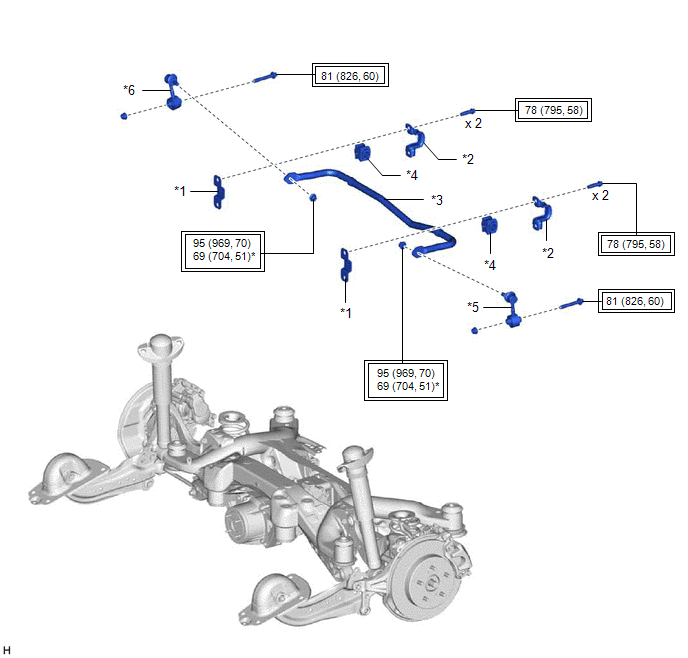
|
*1 | REAR LOWER STABILIZER BRACKET |
*2 | REAR NO. 1 STABILIZER BAR BRACKET |
|
*3 | REAR STABILIZER BAR |
*4 | REAR STABILIZER BUSHING |
|
*5 | REAR STABILIZER LINK ASSEMBLY LH |
*6 | REAR STABILIZER LINK ASSEMBLY RH |
.png) |
Tightening torque for "Major areas involving basic vehicle performance such as moving/turning/stopping": N*m (kgf*cm, ft.*lbf) |
* | For use with a ball joint lock nut wrench |
READ NEXT:
 Removal
REMOVAL CAUTION / NOTICE / HINT
The necessary procedures (adjustment, calibration, initialization, or registration) that must be performed after parts are removed and installed, or replaced during r
Inspection
INSPECTION PROCEDURE 1. INSPECT REAR STABILIZER LINK ASSEMBLY
(a) Inspect the turning torque of the ball joint.
(1) Secure the rear stabilizer link assembly in a vise using aluminum plates.
NOT
Installation
INSTALLATION PROCEDURE 1. INSTALL REAR STABILIZER BUSHING
(a) Install the 2 rear stabilizer bushings to the outside of the stoppers on the rear stabilizer bar.
NOTICE: Be sure to install the
SEE MORE:
Lost Communication with Wiper System LIN BUS (B1373)
DESCRIPTION The main body ECU (multiplex network body ECU) and windshield wiper motor assembly communicate via LIN communication. The main body ECU (multiplex network body ECU) stores this DTC if communication becomes abnormal.
DTC No. Detection Item
DTC Detection Condition
Trou
Fail-safe Chart
FAIL-SAFE CHART If the following DTC is stored, the ECM enters fail-safe mode to allow the vehicle to be driven temporarily.
DTC No. Fail-safe Operation
Fail-safe Deactivation Condition
P161A87 Generator command is fixed.
Engine switch is turned on (IG) after condition r
© 2023-2026 Copyright www.tocamry.com
