
Toyota Camry (XV70): If the vehicle becomes stuck
Carry out the following procedures if the tires spin or the vehicle becomes stuck in mud, dirt or snow:
1. Stop the engine. Set the parking brake and shift the shift lever to P.
2. Remove the mud, snow or sand from around the front wheels.
3. Place wood, stones or some other material under the front wheels to help provide traction.
4. Restart the engine.
5. Shift the shift lever to D or R and release the parking brake. Then, while exercising caution, depress the accelerator pedal.
■When it is difficult to free the vehicle
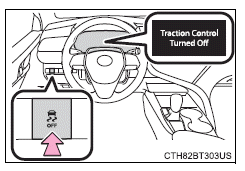
Press  to turn off TRAC.
WARNING
■When attempting to free a stuck vehicle
If you choose to push the vehicle back and forth to free it, make sure the surrounding area is clear to avoid striking other vehicles, objects or people.
The vehicle may also lunge forward or lunge back suddenly as it becomes free. Use extreme caution.
■When shifting the shift lever
Be careful not to shift the shift lever with the accelerator pedal depressed.
This may lead to unexpected rapid acceleration of the vehicle that may cause an accident resulting in death or serious injury.
NOTICE
■To avoid damaging the transmission and other components
- Avoid spinning the front wheels and depressing the accelerator pedal more than necessary.
- If the vehicle remains stuck even after these procedures are performed, the vehicle may require towing to be freed.
READ NEXT:
 Maintenance data (fuel, oil level, etc.)
Dimensions and weights (2WD models)
*1: Unladen vehicles
*2: For LE or XLE grade models
*3: For SE or XSE grade models
*4: 205/65R16 tires
*5: 215/55R17 tires and TRD models with 235/40R19 tire
SEE MORE:
Parts Location
PARTS LOCATION ILLUSTRATION
*A w/ Side Turn Signal Light
- -
*1 HEADLIGHT ASSEMBLY RH
- TURN SIGNAL LIGHT *2
HEADLIGHT ASSEMBLY LH - TURN SIGNAL LIGHT
*3 SIDE TURN SIGNAL LIGHT ASSEMBLY RH
*4 SIDE TURN SIGNAL LIGHT ASSEMBLY LH
*5 REAR COMBI
Approach warning (vehicle-to-vehicle distance control mode) - Dynamic radar cruise
control
When your vehicle is too close to
a vehicle ahead, and sufficient
automatic deceleration via the
cruise control is not possible, the
display will flash and the buzzer
will sound to alert the driver. An
example of this would be if
another driver cuts in front of you
while you are following a
